White Elephant Rules: Steals, Freezes and Why Turn Order Matters
The argument starts before the first gift
Most White Elephant games start with the same pause: who goes first? Everyone has heard that going last is best. Somebody suggests drawing numbers from a hat. Someone else says the first player should get one more turn at the end to make it fair. And then the game starts ten minutes late.
When I built the White Elephant wheel to draw the order, I wanted to know whether that last-turn fix actually makes things fair. So I simulated it. The answer is below, after the rules.
The rules most groups play
There's no official rulebook, so these are the common house rules. Say yours out loud before anyone opens anything.
- Everyone brings one wrapped gift within an agreed price limit, and the gifts go in a pile.
- Draw the turn order.
- On your turn, either open a wrapped gift from the pile or steal an opened gift from someone else.
- If your gift is stolen, you go again straight away. You can open a new gift or steal a different one, but not steal back the gift just taken from you.
- A gift freezes after its third steal and stays with whoever holds it.
- The game ends when the last wrapped gift is opened and any steal chain it starts has finished.
Yankee Swap and similar names usually mean the same game with slightly different steal limits. The limit matters more than the name.
Is going last really better? I simulated it
I played forty thousand ten-person games in a simple model. Every gift has a value that everyone agrees on. On your turn you steal the best gift you're allowed to take if it beats what you'd expect from a wrapped one, and otherwise you open one. Steal chains, the no-steal-back rule and the freeze after three steals all work as above. If seating made no difference, every seat would end up with the best gift 10% of the time.
- The last seat got the best gift 16% of the time, and finished with the 4th-best gift on average.
- Seats 2 and 3 did worst, at about 6% each. The first player only opens, and the next two players face a table with almost nothing worth stealing.
So yes, the folk wisdom holds. Going last is a real advantage.
The usual fix goes too far
The popular correction is to give player 1 one final turn at the end, when they can swap their gift for any unfrozen one. In the same model, that made seat 1 the best seat by a long way: the best gift 29% of the time, nearly three times a fair share. The last seat dropped to about 5%.
It makes sense once you see it. A final turn with every gift on the table is a bigger advantage than going last, because the last player still has to choose before player 1 does.
Real groups don't all agree on what a gift is worth. One person's novelty mug is another's prize, so the effect at your party will be smaller than in my model. But the direction is clear. If you add the final-turn rule, the order still matters, just at the other end.
What I'd do instead
- Keep the final turn, but let it only take a gift with fewer than three steals. That's the rule above anyway. Say it explicitly, because many groups forget the freeze applies to the bonus turn.
- Or drop the bonus and draw the order fairly. Accept that seat matters and make sure nobody chose their seat. That's the simplest fair version.
- Use a lower steal limit, like two steals before a freeze, for a quicker game with less end-of-game advantage.
Drawing the order fairly
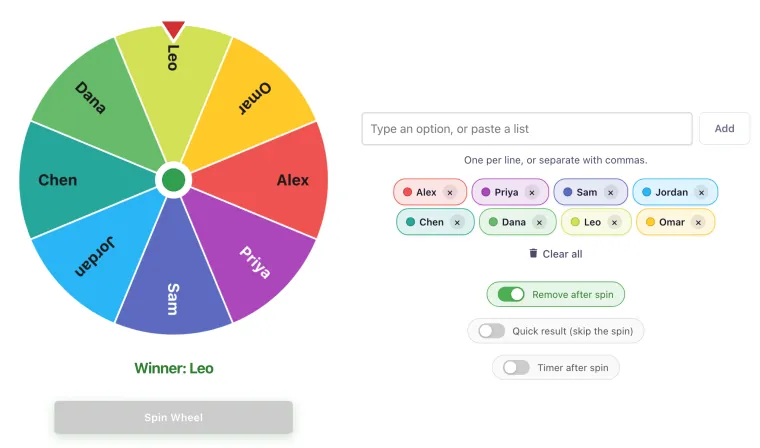
Since the order matters, it's worth drawing it where everyone can see. Open the White Elephant wheel, replace Player 1 to Player 10 with your names, and turn on Remove after spin. Spin once per person. The order names come off the wheel is the order of play. Put it on the TV and the draw takes about a minute, and nobody is holding the hat.
The pick is made by your browser's Web Crypto random generator before the wheel moves. The animation shows a result that's already fixed, so nobody can stop it on themselves. The randomness page has the details.
A different game: keep the gifts wrapped
If your group finds the stealing too cutthroat, try the gift exchange wheel. Everyone holds a wrapped gift in a circle, and each spin says pass left, pass right, swap, steal an unopened gift, or open yours. Nobody knows what they're holding for most of the game, so there's nothing to fight over. One slice in eight is "Open your gift", so add a second one for a big group if the game drags.
And if everyone is buying for one named person instead, that's Secret Santa. The Secret Santa generator draws it with private links and no email, and the Secret Santa post shows how often drawing from a hat goes wrong.
What the wheel won't do
- It doesn't track steals. Count them on a sticky note on each gift, or put a sticker on it each time it's stolen.
- It doesn't enforce rules. It only draws the order, so agree the steal limit and the final-turn rule first.
- The simulation is a model, not a promise. Real players value gifts differently and bluff, and your party will be noisier than my code.
Frequently Asked Questions
What are the basic White Elephant rules?
Everyone brings one wrapped gift. Draw the turn order. On your turn, open a wrapped gift or steal an opened one. If your gift is stolen you go again straight away but cannot steal it back. A gift freezes after its third steal. These are common house rules, so agree yours first.
Is it better to go first or last in White Elephant?
Last, under the usual rules. In my simulation of 40,000 ten-player games where everyone values the gifts the same, the last seat ended with the best gift 16% of the time against a fair 10%, while seats 2 and 3 got it only about 6% of the time.
Does giving the first player a final turn make it fair?
Not in my simulation. With a final swap at the end, player 1 got the best gift about 29% of the time, nearly three times a fair share. Real groups value gifts differently, so the effect is smaller in practice, but the advantage moves to the first seat rather than disappearing.
How many times can a gift be stolen?
Most groups freeze a gift after its third steal, so it stays with whoever holds it. A limit of two makes a shorter game.
Can you steal back a gift that was just taken from you?
Not under the common rules. You take another turn straight away, but you have to open a new gift or steal a different one.
How do I draw the White Elephant turn order?
Put every player's name on the White Elephant wheel, turn on Remove after spin, and spin once per person. The order the names come off is the order of play.
Is White Elephant the same as Yankee Swap?
They are names for the same kind of game. Groups use different steal limits and end rules, which matter more than the name.