Thanksgiving and Christmas Bingo: Picture Cards and How Long a Game Takes
The question nobody answers: how long will this take?
When I made the Thanksgiving bingo page, I wrote that a line "usually comes in somewhere around the middle of the list." Then I realised I didn't know that. It depends on how many people are playing, and most printable bingo pages skip that part. It's the part that matters most when you have twenty minutes before the turkey comes out, or forty minutes of class party.
So I simulated it. I built cards the way the page builds them, 24 words at random around a free centre, and called words in random order until someone got a line. I ran four thousand games for each group size. The numbers are below, and they changed how I'd run a game.
What's on the cards
- Thanksgiving: 45 words, each with a picture. Turkey, pumpkin pie, sweet potato, parade balloon, grandma, nap.
- Christmas: 46 words with pictures.
- Halloween is there too, with 48 words, if you're reading this in October.
Every card takes 24 of the words at random around a free centre square, so no two cards in a pack match. You can print up to 100 cards, on A4 or Letter, with one, two or four cards per sheet. Two per sheet is the size I'd pick for small hands. The pictures are what make it work across ages, because a child who can't read yet can still find the turkey. Switch them off for a table of adults and it becomes a quick reading game.
How many calls until someone shouts bingo
These are the median number of words called before the first card in the room has a line. A line can be a row, a column or either diagonal. The figures come from my simulation of the 45-word Thanksgiving list:
- 1 player: about 25 calls
- 5 players: about 18
- 10 players: about 16
- 20 players: about 14
- 30 players: about 13
Christmas has one more word, which barely moves these numbers. Halloween's 48 words add one or two calls at each size.
Two things surprised me. First, adding players shortens the game a lot at the start and hardly at all after that. Going from one card to ten cuts nine calls. Going from twenty to thirty cuts one. Second, a whole class of thirty gets a winner after about thirteen words, barely a quarter of the list. If you call one word every ten seconds or so, reading it out and showing the picture, that's a little over two minutes.
What that means for planning
At a class party
With 25 to 30 children, one line game is over in about two or three minutes. That's too quick to fill a party slot on its own, but it leaves room for several rounds. Play three or four line games with a small prize each, then finish with one full-card game if the room still has energy. A full card needs every one of a card's 24 words, so it runs most of the way through the list. Keep that for the end, when you want a longer stretch.
At a family table
Six or eight people get a line after roughly seventeen or eighteen calls. That's about three minutes at a steady pace, which suits the gap before dinner. Don't clear the cards between rounds. Keep calling and play "first to two lines," then "first to four corners." The game gets longer without anyone needing a new card.
With very small children
Fewer players means a longer wait, and a four-year-old waiting 25 calls for a line is a four-year-old under the table. If it's two adults and one child, give the child two cards. It roughly halves the wait and doubles the excitement.
Calling it
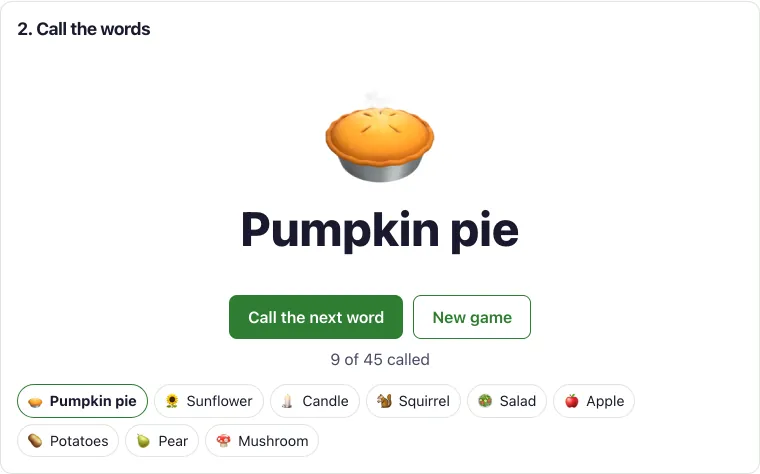
Open the page on a laptop, or put it on the TV or classroom projector, and press Call a word. It draws the next word at random from the words not yet called, so nothing comes up twice. It shows the word with its picture large enough to see from the back of the room, and every word called so far is listed underneath. Both the cards and the calls use your browser's Web Crypto random generator, the same one behind every PickerSpin tool. The randomness page explains how that works if a sceptical uncle asks.
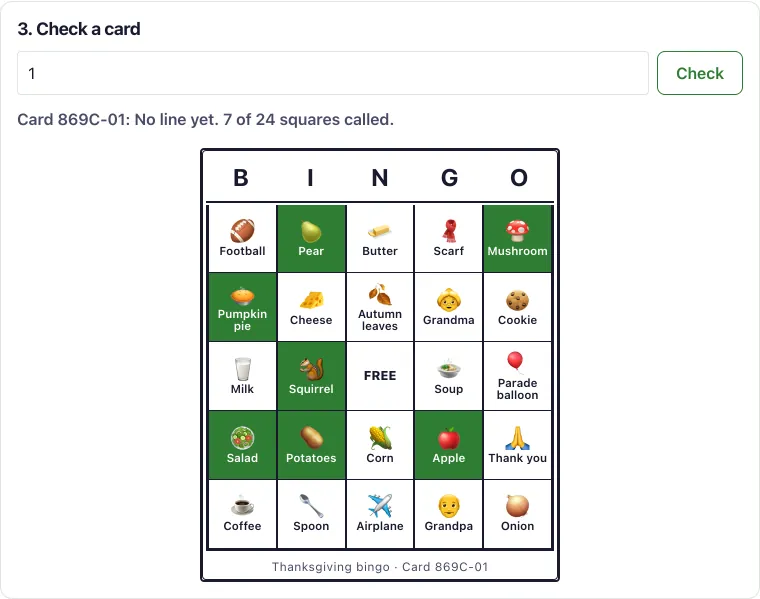
When someone shouts bingo, type their card number into Check a card. The page shows their card with the called words marked and tells you whether the line is real. That saves the argument that otherwise follows every win at a family table.
Make it yours
The word list is editable. Swap in your family's dishes, or this week's vocabulary words for a classroom version. You need at least 24 words for the cards to fill. Words you type print without a picture, so mix a few of your own into the built-in list rather than replacing all of it if young children are playing.
A gratitude round works well at a family table. Whoever marks a square says one thing they're thankful for that fits the word. Grandma is easy. Onion takes some thought.
What it won't do
- No automatic calling or voice on these pages. You press the button for each word. The number bingo caller has auto-call and a spoken voice if you'd rather play classic 1-75 bingo.
- It won't mark players' cards for them. The cards are printed, so players cover squares with beans, popcorn kernels or coins.
- Custom words have no pictures. Only the built-in words have them.
- The simulation is a guide, not a promise. These are medians. One game in ten will end noticeably sooner or later.
Prizes
If several children get a line on the same call, don't adjudicate. Spin the wheel with their names on it and let it pick. Turn on Remove after spin across the afternoon and nobody takes home two prizes.
For classic number bingo, how long a bingo game takes has the same figures for 75-ball and 90-ball games, and the virtual bingo night guide covers playing over a video call.
Players on phones? Host it online and claims are checked automatically.
Frequently Asked Questions
How many calls does a bingo game take?
With PickerSpin's 45-word Thanksgiving cards, my simulation of 4,000 games per group size found the first line comes after about 25 calls with one player, 18 with five, 16 with ten, 14 with twenty and 13 with thirty. Those are medians, so individual games vary.
Can young children who cannot read play?
Yes. Every built-in word has a picture on the card and on the caller screen, so children can match pictures instead of reading. Turn pictures off for older players who want a reading game.
How many cards can I print?
Up to 100, each unique, on A4 or Letter paper with one, two or four cards per sheet. Each card has its own number for checking a win.
How do I check if someone really has bingo?
Type their card number into Check a card. The page shows the card with the called words marked and says whether a row, column or diagonal is complete.
Can I add my own words?
Yes. The list is editable and needs at least 24 words. Words you add yourself print without a picture.
Does the holiday bingo caller call words automatically?
No. On the seasonal pages you press Call a word for each one. The number bingo caller at /bingo has auto-call and a spoken voice.
How do I make a bingo game last longer?
Keep calling after the first line and play for two lines, four corners, then a full card. A full card needs all 24 of a card's words, so it runs most of the way through the list.