How Long Does a Bingo Game Take? Calls and Minutes for 75 and 90 Ball
"How long will it take?" has a real answer
If you're planning a bingo night, you need to know how long a game takes. A school fundraiser has a hall booked until nine. A family tambola has to fit between dinner and the kids' bedtime. A care home has an hour before tea. Most guides say "it depends." It does, but it depends on two things you know in advance: how many people are playing, and how fast you call.
So I simulated it. I generated cards the way real ones are laid out, called numbers in random order, and recorded when the first person in the room would have won. I did that three thousand times for each group size, for both formats: the bingo caller for 75-ball games and the tambola number generator for 90-ball. These are the results.
75-ball bingo: calls until someone wins
These are the median number of calls before the first card in the room completes the prize. A line can be any row, column or diagonal.
- 1 card: first line after about 42 calls, a full card after 74
- 10 cards: line about 26, full card about 69
- 20 cards: line about 22, full card about 67
- 50 cards: line about 19, full card about 65
Look at the full-card column. With 75 numbers in the drum, a blackout takes most of the drum however many people play. Fifty cards only save you about ten calls over one. A line game is different. More players shorten it a lot, at least up to about twenty cards.
90-ball tambola: early five, lines and full house
Tambola and Housie use a ticket of 15 numbers in three rows, and usually several prizes in one game. Medians for the first ticket to win each prize:
- 10 tickets: early five after about 15 calls, first line about 44, full house about 77
- 20 tickets: early five 13, first line 38, full house 74
- 50 tickets: early five 11, first line 32, full house 70
The early five goes fast. With a room of fifty it's often claimed before the caller has reached a dozen numbers, so have that prize ready before you start. The "first line" figure is for any row. If your group plays top, middle and bottom line as separate prizes, each of those takes longer than this.
From calls to minutes
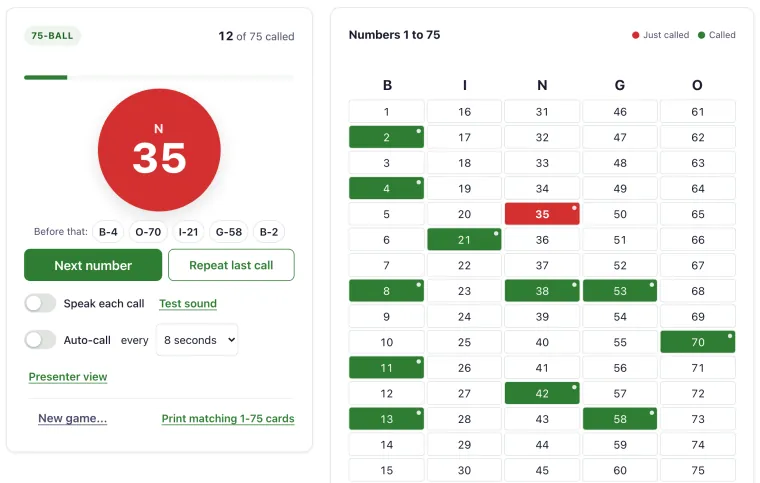
Both callers have Auto-call every 5, 8, 12 or 15 seconds, with 8 as the default. For a 20-player game that works out as:
- 75-ball line (22 calls): about 2 minutes at 5 s, 3 at 8 s, 4.5 at 12 s, 5.5 at 15 s
- 75-ball full card (67 calls): about 6, 9, 13 and 17 minutes
- 90-ball full house (74 calls): about 6, 10, 15 and 18.5 minutes
Those are calling times only. Every claim needs checking, and in a big room that's another minute or two per prize. A three-prize tambola with 20 players at 8 seconds is realistically a 15-minute game, not 10.
Picking a pace
5 seconds
For experienced players with one card each, or a quick online game where everyone marks on their phone. Too fast for anyone with three tickets.
8 seconds
The default, and the right speed for most family and office games. It's enough time to hear the number, find it and dab.
12 seconds
For mixed ages, players with several cards, or a noisy hall. It's also what I'd use for tambola where people hold two or three tickets.
15 seconds
For young children, care homes, and anyone playing in a second language. It feels slow to the caller and right to the players.
Whatever you choose, start slower than you think. You can speed up after the first game, but players who miss numbers early stay frustrated for the evening.
Calling with sound
Turn on the voice and the caller speaks each number using your browser's built-in voice. The 75-ball caller says the letter and number, "B, 7". The tambola caller reads two-digit numbers digit by digit and then whole, "four, seven, forty-seven", the way a Housie caller does, so 47 isn't misheard as 14. Press Test sound before guests arrive and check the volume from the back of the room, not the front. Repeat last call says the previous number again without drawing a new one.
For a big room, open Presenter view on a TV or projector. If you switch tabs, auto-call pauses itself so numbers don't bunch up when you come back. Every number is drawn with your browser's Web Crypto random generator and never repeats in a game. The randomness page lets you test that yourself.
Planning a full evening
For a two-hour fundraiser with 20 to 30 players at 8 seconds, I'd plan five or six games: two or three quick line games, two tambola games with early five, line and full house, and one full-card game to finish. Leave a break in the middle. After about four games, the people dabbing need it more than the caller.
For printable 75-ball cards, use the bingo card generator. If you're not sure which format your group means, the bingo vs tambola guide sorts it out in a minute. Running the evening over a video call? The virtual bingo night guide covers that, and for a holiday party with young children, picture bingo runs to a different clock.
What the callers won't do
- They don't check tickets automatically for tambola. The caller has no tickets of its own, so check claims against the board of called numbers on screen.
- The voice depends on your browser. Some browsers have no built-in voice. The page tells you if so, and calls still show on screen.
- No traditional nicknames spoken aloud. The voice reads the number. If your group loves "two little ducks", that's the caller's job. The tambola rules post lists the classic calls.
- These are medians. About one game in ten will end noticeably sooner or later than the figures above.
Running the game on phones? Host it online and claims are checked the moment someone presses Claim, which takes the longest pause out of every round.
Frequently Asked Questions
How many numbers are called in a game of bingo?
For 75-ball bingo with 20 cards, my simulation found the first line comes after about 22 calls and a full card after about 67. With one card it is about 42 and 74. A full card takes most of the drum however many people play.
How long does a game of tambola take?
With 20 tickets, a full house comes after about 74 numbers in my simulation. At 8 seconds a call that is about 10 minutes of calling, plus time to check claims, so plan on 15 minutes for a game with three prizes.
How fast should you call bingo numbers?
Eight seconds suits most family and office games. Use 12 seconds for players with several cards or mixed ages, 15 for young children or care homes, and 5 only for experienced players with one card each.
Can the bingo caller call numbers automatically?
Yes. Both the 75-ball and 90-ball callers have Auto-call every 5, 8, 12 or 15 seconds. It starts paused, stops when every number is called, and pauses if you switch tabs.
Does the caller speak the numbers?
Yes, with your browser's built-in voice. The 75-ball caller says the letter and number, and the tambola caller reads two-digit numbers digit by digit and then whole, like four, seven, forty-seven.
How quickly is early five won in tambola?
Quickly. My simulation found it after about 15 calls with 10 tickets and about 11 with 50, so have that prize ready before you start calling.
Do more players make a bingo game shorter?
For line games, yes, up to about 20 cards. For a full card or full house, only a little: 50 cards finish just a few calls sooner than 10, because almost every number has to come out.