Spin the Wheel 1-20: Number Wheel Games for Math Class
A wheel for "pick a number"
Of all the number wheels on the site, the 1 to 20 wheel is the one people find most often when they search. I think I know why. Twenty is a class register, a set of raffle tickets at a school fair, a page of numbered questions, or a d20 when the dice bag has gone missing. When the things you are choosing from already have numbers, you do not need to type them onto a wheel. You need twenty slices and a fair spin.
I spun the 1 to 10 wheel while writing this and it landed on 8. Nothing interesting about 8. The point is that nobody in the room chose it, and that is what a number wheel is for.
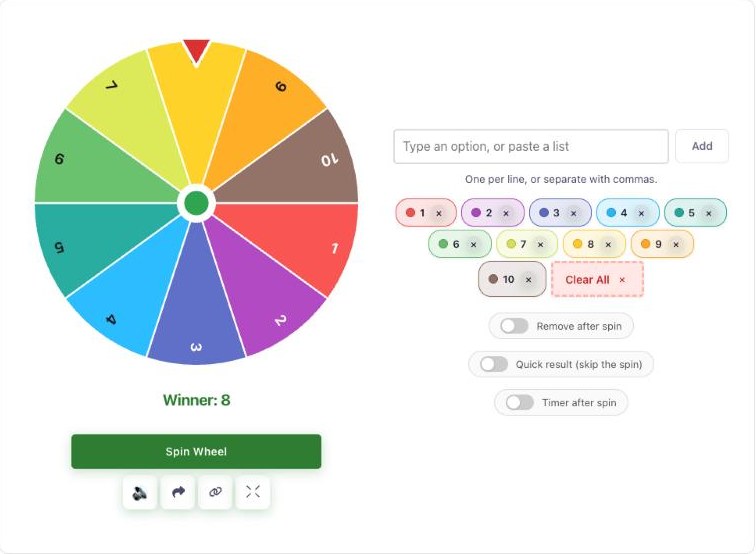
Pick the range that matches what you are numbering
- 1 to 6 is a die. Use it when the dice have gone missing, or the dice roller when you want it to look like a roll.
- 1 to 10 is the mental math wheel, small enough that every slice is readable on a projector.
- 1 to 20 fits most class registers and numbered question sets, and it doubles as a d20 for a tabletop game.
- 1 to 50 and 1 to 100 are for raffles and guessing games. At a hundred slices the wheel is a blur until it stops, and the winner is shown clearly underneath.
- Anything else, such as 5 to 25 or 0 to 99, goes on the random number wheel, a random number generator where you type the minimum and maximum. The range can be up to 200 wide, so 1 to 200 works, and it keeps a list of the numbers picked.
Numbering students instead of naming them has a side benefit. No names go into a browser tool at all, and the same wheel works for every class you teach.
Five quick math games
1. Spin twice and add
Two spins of the 1 to 10 wheel, and the class adds them. It works for number bonds with younger students and as a warm-up for anyone. Have them predict the total before the second spin, because that is where the next section starts.
2. Times tables, one factor fixed
"Today is the sevens." Write 7 on the board and spin for the other number. That way, every spin is a fact you actually want practised. Spinning both numbers sounds better than it is, for reasons below.
3. Find the difference
Spin twice and ask for the gap between the numbers. It is quick, it works for every age, and it gives a lot of small answers, which suits younger classes.
4. Higher or lower
One student spins the 1 to 100 wheel with the screen turned away, and the class guesses. The spinner only answers "higher" or "lower". A good class can always find the number in seven guesses, because halving 100 seven times gets you below one. That is a nice thing to discover rather than be told.
5. Spin, then go
Spin for a number of seconds, star jumps or words in a sentence. Turn on Timer after spin and the countdown starts when the wheel lands, not when you press the button. There is more on that in the spin timer post.
Two spins are not one bigger wheel
This catches out nearly everyone, and it is worth a lesson of its own. Each spin of the 1 to 10 wheel is fair: every number has exactly a one in ten chance. But add two spins and the totals are not fair at all.
There are 100 equally likely pairs of spins. Only one of them, 1 and 1, makes 2, and only one, 10 and 10, makes 20. Ten different pairs make 11. So a total of 11 comes up 10% of the time, while 2 and 20 come up 1% each, and 1 never comes up at all. If you wanted a random number from 1 to 20, two spins of the 1 to 10 wheel will not give you one. Use the 1 to 20 wheel.
Multiplying has a quieter version of the same problem. Each ordered pair is equally likely, but 7 × 8 can arrive as 7 then 8 or 8 then 7, while 7 × 7 can only arrive one way. So the squares come up half as often as the other facts, and the squares are often the ones students struggle with. Worse, more than a third of all two-spin rounds (36%) include a 1 or a 10, which are the facts nobody needs to practise. Fixing one factor avoids all of it. If you would rather spin both, delete the 1 and 10 slices first.
Ask the class to tally fifty two-spin totals on the board and the hump around 11 appears on its own. Once they have seen it, why two dice make 7 more than anything else stops being a rule to memorise. The deck of cards probability lesson takes the same idea further.
Stopping repeats
Without removal, every spin starts fresh, so repeats come quickly. Spin the 1 to 20 wheel five times and there is about a 42% chance one number comes up twice. By ten spins it is about 94%. Waiting for all twenty numbers to come up takes around 72 spins on average. That is fine for a game, and useless for "everyone gets one turn".
For turns, switch on Remove after spin. A moment after each result is shown, that number drops off the wheel, so twenty spins give you all twenty numbers in a random order. The toggle stays how you left it in this browser, so check it before a game where repeats are the point. To put every number back, reload the page.
If you number students for cold-calling, the classroom spinner does the same job with names and keeps track of who has had a turn.
What the number wheels will not do
- The number pages do not keep a list of results. They show the latest winner, not a history. Write results on the board as you go, which is also where the class can see them, or use the random number wheel, which lists every number it has picked.
- They do not keep your edits. Delete the 1 and the 10, or add a 0, and it works until you reload. Then the page brings back its original numbers. To keep a custom set, build it on the main wheel and save it in the Wheels tab.
- There is no zero. Every preset starts at 1. For place value games with digits 0 to 9, set the random number wheel to 0 to 9.
- One number per spin. For two numbers, spin twice, and remember what that does to totals.
What they do guarantee is the draw. Each number is picked with the browser's cryptographic random number generator before the wheel starts turning, so every slice really does have the same chance. You can run the check yourself on up to 100,000 simulated spins. The rest of the classroom tools are on the teacher page, all free, with no signup and no ads.
Spin the Wheel 1-20: Number Wheel Games for Math Class - questions
Is there a spin the wheel for numbers 1 to 20?
Yes. The 1 to 20 number wheel has twenty equal slices already loaded, so you can spin straight away, and it works as a d20 too. There are also ready-made wheels for 1 to 6, 1 to 10, 1 to 50 and 1 to 100, and a random number wheel where you type any minimum and maximum up to 200 apart.
Are all the numbers on the wheel equally likely?
Yes. Every slice is the same size, and the winning number is picked with the browser's cryptographically secure random number generator before the wheel starts turning. On the 1 to 20 wheel each number has a one in twenty chance on every spin.
Is spinning a 1 to 10 wheel twice the same as spinning 1 to 20?
No. Adding two spins gives totals from 2 to 20, and they are not equally likely. A total of 11 comes up 10% of the time, while 2 and 20 come up only 1% each, and 1 is impossible. For an even chance across 1 to 20, use the 1 to 20 wheel.
How do I stop the same number coming up twice?
Switch on Remove after spin. Each number leaves the wheel shortly after it is drawn, so twenty spins of the 1 to 20 wheel give all twenty numbers in a random order. Reload the page to put them all back.
Can I use the number wheel for times tables?
Yes. The best way is to fix one factor ("today is the sevens") and spin for the other. If you spin both, the 1 and 10 slices turn up in more than a third of rounds, and square facts such as 7 × 7 come up half as often as the others. Deleting the 1 and 10 slices helps.
Can the wheel include 0?
The preset wheels start at 1. Set the random number wheel to 0 to 9 for digit games, or add a 0 slice by hand. Edits on the preset pages last until you reload.
Does the wheel remember which numbers came up?
The number pages show the most recent result only, so write results on the board or use Remove after spin so drawn numbers leave the wheel. The random number wheel keeps a Numbers Picked list for the session, with a Clear button.