How to Solve a 9x9 Sudoku: Cross-Hatching, Naked and Hidden Singles
The rule fits in one sentence
Fill the 9x9 grid so every row, every column and every 3x3 box holds the digits 1 to 9, once each. That is the whole rule. There is no arithmetic in it. The digits could just as well be nine colours or nine letters.
The rule nobody prints on the puzzle took me longer to learn: a proper sudoku has exactly one solution. I found out how much that matters the hard way. Until this week the PickerSpin Sudoku page never checked it. When I tested 2,000 of its puzzles, 1,196 had two or more answers, so a player could fill in a perfectly valid grid and never see it count as solved. It checks every puzzle now.
For a solver, that one-answer rule is the most useful thing to know, because it means you never have to guess. If every step is forced, you are solving. If you are choosing between two digits and hoping, you have either missed something or the puzzle is broken.
Why one answer matters
The fewer numbers a puzzle gives you, the more room there is for a second answer to slip in. In 2012, Gary McGuire, Bastian Tugemann and Gilles Civario settled how few is too few. After an exhaustive computer search, they showed there is no 16-clue sudoku with a unique solution. Seventeen is the minimum.
The reverse does not hold. Plenty of puzzles with far more than 17 clues still have two or more solutions, because the clues are in the wrong places. The PickerSpin puzzles had 41 clues each and still went wrong most of the time. A good generator does not just blank out cells. It checks after every removal that the answer is still unique, and puts the number back when it is not.
Step 1: Cross-hatch before you write anything
Pick a digit, say 1, and look at the three boxes in the top band. If two of them already contain a 1, the third box's 1 must go in the one row those two have not used. Often only one empty cell in that row is still open, and that cell is your answer. Running your eye along the rows and down the columns like this is called cross-hatching, or scanning.
Do it for every digit, across all three bands and then down all three stacks of boxes. It is quick, and on an easy puzzle it fills a good share of the grid before you need anything cleverer. Start with the digit that already appears most often. It has the fewest places left, so it is the most likely to be forced.
Step 2: Naked singles (one cell, one possible digit)
Take one empty cell. Cross out every digit that already appears in its row, its column and its box. If only one digit is left, that is the answer. It is called a naked single because nothing else in the cell is hiding it.
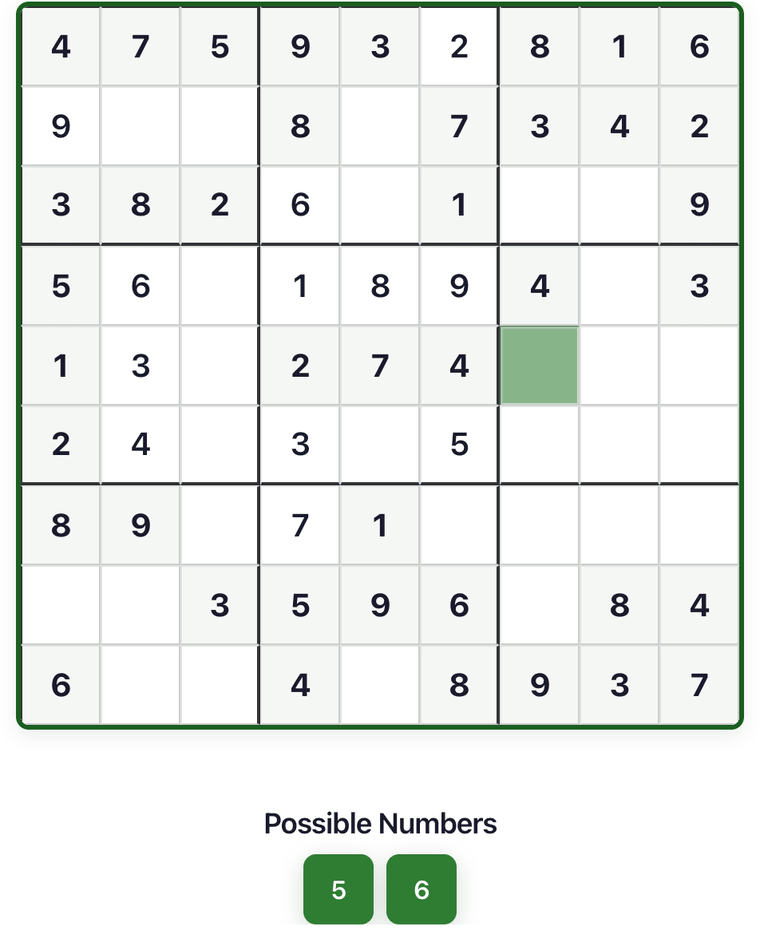
On PickerSpin you can see this directly. Tap an empty cell and the Possible Numbers panel shows exactly the digits its row, column and box still allow. One button means a naked single. The panel only knows what is on the board, though. If you put a wrong digit in earlier, the panel treats it as true, so it can still offer a number that leads you into a dead end. That is why it pays to understand the method instead of trusting the buttons.
Step 3: Hidden singles (one digit, one possible cell)
This one turns the question around. Instead of asking what can go in this cell, ask where the 7 can go in this box. A cell might still allow 2, 5 or 7. But if it is the only cell in its box, row or column where a 7 can go, it is the 7.
Boxes are the easiest place to spot these, because the nine cells sit close together. Work through a box one digit at a time and you will find hidden singles that cell-by-cell checking walks straight past.
Step 4: Look again after every number you place
Every digit you write removes options from up to twenty other cells: the rest of its row, its column and its box. So the moment you place one, look at those neighbours again. New singles nearly always turn up right next to the last one. A solve is usually a chain like that, not a series of separate discoveries.
When you are stuck
- Scan again, digit by digit, box by box. Most of the time a hidden single was there and you missed it.
- Write candidates in every empty cell if you are on paper. The patterns harder puzzles need, like naked pairs (two cells in a row, column or box that can only hold the same two digits, so nothing else there can) and the X-wing, only show up once the candidates are written down.
- Check for a dead cell. On PickerSpin, if you tap an empty cell and the panel says no number fits, an earlier entry is wrong. Undo until the cell has options again, or tap the number you doubt and change it.
- Do not guess and carry on. On a real puzzle, guessing is a slow way to do what logic does in one step. If you do test a digit, do it somewhere you can undo it.
What PickerSpin's Sudoku does, and what it does not
It deals a fresh 9x9 puzzle with 41 numbers filled in and exactly one solution, in your browser, with no account and no ads. You get the Possible Numbers panel, the option to change or clear any number you entered, Undo and Redo, Reset to go back to the starting grid, and New Game. An unfinished puzzle is saved in your browser, so closing the tab does not lose it. When every row, column and box checks out, it tells you the puzzle is solved.
The limits, plainly:
- There is one difficulty, and it is easy. I generated 2,000 puzzles with the new code and 98% of them fall to naked singles alone. If you already know the method above, they are warm-ups, not real tests.
- No pencil marks of your own. The panel shows candidates for one cell at a time, but you cannot write notes in the grid. Harder techniques need that.
- No hint that fills in a cell. The panel tells you what can go in a cell, never which number is right.
- No mistake warnings. Nothing highlights a wrong digit as you go. You find out from a dead cell later on.
- Saving is per browser. Your puzzle is kept on the device and browser you played it on. A private window or a different browser starts fresh.
If you want a different kind of logic after a few grids, the number slide puzzle and tile fitter are in the same corner of the site, and so are the treasure hunt and the maze builder. The rest of PickerSpin is the opposite of sudoku. Tools like the spin the wheel picker and the dice roller leave the answer to chance instead of logic.
A short version to keep
- Cross-hatch each digit across the bands and stacks.
- Fill any cell with only one possible digit (naked single).
- Fill any digit with only one possible cell in a box, row or column (hidden single).
- After every placement, check its row, column and box again.
- Stuck? Scan again, then write candidates. Never guess on a real puzzle.
Then open a fresh grid and try it.
How to Solve a 9x9 Sudoku: Cross-Hatching, Naked and Hidden Singles - questions
How do you solve a 9x9 sudoku for beginners?
Cross-hatch each digit across the rows and boxes to find cells where it is forced, then look for naked singles (a cell with only one possible digit) and hidden singles (a digit with only one possible cell in a row, column or box). After each placement, check that cell's row, column and box again. Easy puzzles can be finished with those steps alone.
What is the difference between a naked single and a hidden single?
A naked single is a cell where only one digit is still allowed. A hidden single is a digit that can only go in one cell of a row, column or box, even though that cell might still allow other digits. You look for naked singles cell by cell, and hidden singles digit by digit.
What is cross-hatching in sudoku?
Scanning one digit across a band of three boxes, or down a stack of three. If two boxes already hold that digit, the third box's copy must sit in the row or column the other two have not used, which often leaves only one possible cell.
Does every sudoku have only one solution?
A properly made one does. That is what lets you solve it by logic without guessing. A puzzle with too few clues, or clues in the wrong places, can have two or more valid answers. The minimum for a unique solution is 17 clues, shown by McGuire, Tugemann and Civario in 2012.
What should I do when I am stuck on a sudoku?
Scan each digit box by box first, because a missed hidden single is the most common reason. If that finds nothing, write every candidate into the empty cells and look for pairs. If a cell has no possible digits at all, an earlier entry is wrong.
Is it cheating to use the Possible Numbers panel?
No more than writing pencil marks on paper. It saves you crossing out digits by hand for one cell. It does not tell you which candidate is right, and it only knows what is on the board, so a wrong earlier entry makes its suggestions wrong too.
Does PickerSpin save my sudoku if I close the tab?
Yes, in the same browser on the same device. An unfinished puzzle comes back when you open the page again. A private window, a different browser or clearing your site data starts a new one.